Top 6 Cost Optimization Strategies in AI Systems
Building a proof-of-concept AI app with frontier LLMs takes hours; scaling it to millions of daily production requests without going bankrupt requires disciplined systems engineering. Here is an architectural blueprint covering the 6 proven industry techniques that cut inference and token costs by up to 80% while preserving sub-second latency and model intelligence.
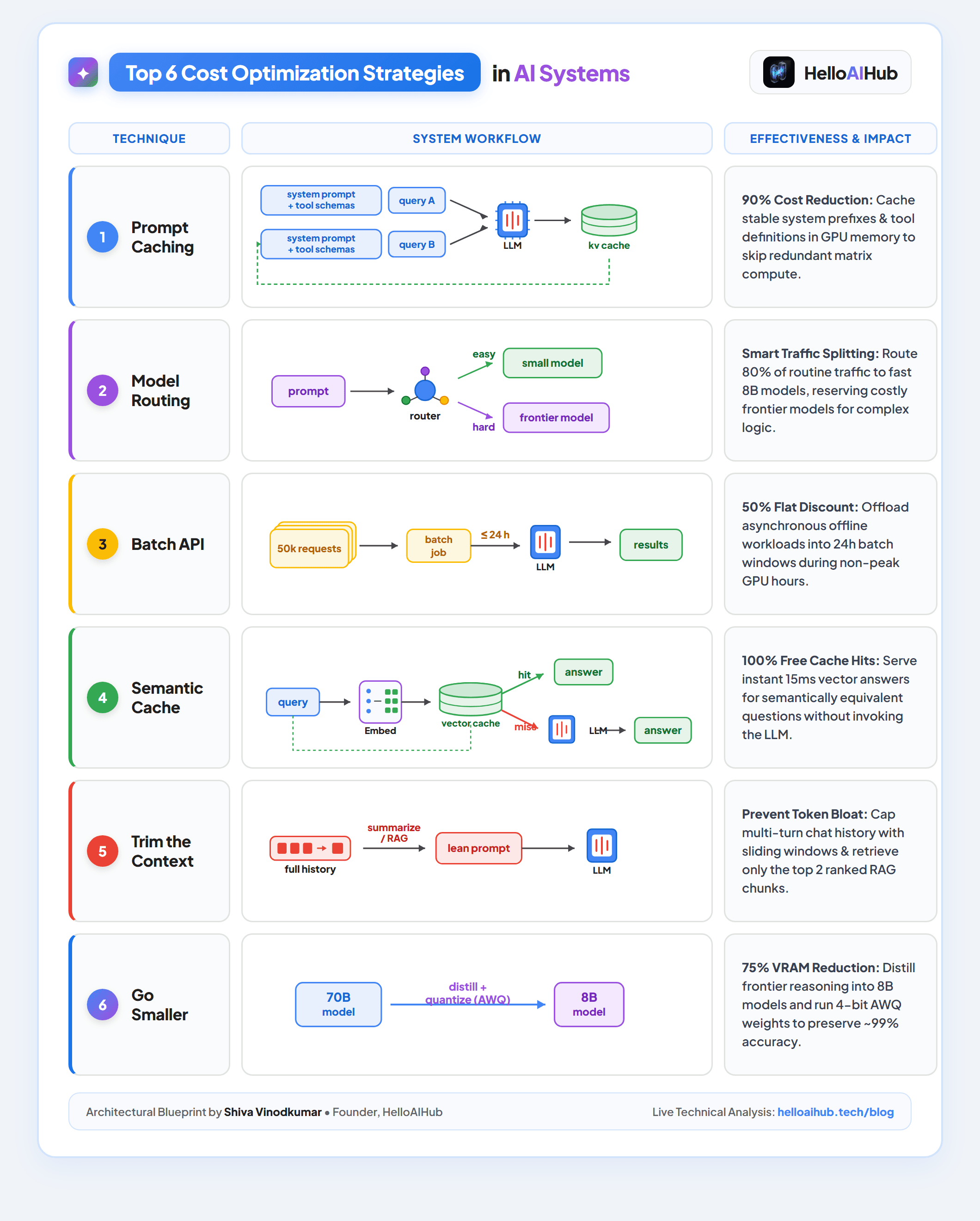
The 6 Pillars of AI Unit Economics
- 1. Prompt Caching: Storing pre-computed KV states for common system instructions and tool definitions to achieve 90% cost reductions and 80% lower time-to-first-token (TTFT).
- 2. Model Routing: Automatically dispatching low-entropy tasks to lightweight SLMs (e.g. GPT-4o-mini, Llama-3-8B) while reserving costly frontier models for complex multi-step reasoning.
- 3. Batch API: Leveraging 24-hour asynchronous processing windows for non-interactive workloads to unlock guaranteed 50% vendor discounts.
- 4. Semantic Caching: Using vector embeddings (cosine similarity ≥ 0.95) to serve cached responses for semantically equivalent queries without invoking the LLM.
- 5. Context Trimming & RAG Pruning: Eliminating token bloat through sliding window conversation summarization and dynamic chunk re-ranking.
- 6. Distillation & 4-bit Quantization: Fine-tuning compact models on frontier reasoning traces and running AWQ/GPTQ weights to slash GPU VRAM footprint by 75%.
1. Prompt Caching: Reusing KV State Across Consecutive Calls
In modern agentic systems, the system prompt, comprehensive instructions, and dozens of JSON-RPC tool schemas can easily consume 4,000 to 10,000 tokens before a single user query is appended. If 1,000 users ask questions, recalculating the self-attention Key-Value (KV) matrices for that identical static prefix 1,000 times wastes thousands of dollars and introduces unnecessary GPU compute latency.
How it works: Providers like Anthropic Claude, Google Gemini, and OpenAI maintain in-memory KV caches for identical prefix sequences. When an incoming request matches a cached prefix, the model skips matrix multiplication for those tokens:
// Anthropic Claude Prompt Caching Implementation
import Anthropic from '@anthropic-ai/sdk';

const anthropic = new Anthropic();

const response = await anthropic.beta.promptCaching.messages.create({
  model: 'claude-3-5-sonnet-20241022',
  max_tokens: 1024,
  system: [
    {
      type: 'text',
      text: LARGE_SYSTEM_PROMPT_WITH_TOOLS, // 8,000 tokens of documentation
      cache_control: { type: 'ephemeral' } // Caches prefix for 5 minutes
    }
  ],
  messages: [
    { role: 'user', content: 'What is our enterprise refund policy for Q4?' }
  ]
});

// Result:
// First call: Writes 8,000 tokens to cache (Standard base cost)
// Subsequent calls: Reads 8,000 cached tokens at 90% DISCOUNT ($0.30/M vs $3.00/M)
2. Model Routing: Directing Traffic by Query Entropy
Not every user query requires a multi-billion parameter frontier reasoning model. In production, 70% to 80% of incoming user requests are simple classification, sentiment extraction, or factual Q&A.
The Architecture: A lightweight classifier (such as an embedding model, DeBERTa, or a specialized routing library like RouteLLM) evaluates incoming query complexity:
// Intelligent Semantic Model Router Pattern
export async function routeQuery(userPrompt: string) {
  // Fast local classification (<10ms, <$0.00001)
  const complexityScore = await calculateEntropyScore(userPrompt);

  if (complexityScore > 0.75) {
    // Hard multi-step logic, code generation, mathematical analysis
    return await callModel('claude-3-5-sonnet-20241022', userPrompt);
  } else {
    // Routine summarization, FAQ lookup, intent routing
    return await callModel('gpt-4o-mini', userPrompt);
  }
}
// Blended Savings: Reduces average cost per 1M queries by ~68%
3. Batch API: Unlocking 50% Off-Peak Cloud Discounts
For workloads that do not demand real-time interactive user responses (e.g. daily catalog categorization, sentiment indexing, nocturnal data scraping, offline report generation), sending synchronous REST API requests is financial malpractice.
OpenAI, Anthropic, and Google offer official Batch APIs that process bulk JSONL jobs within a 24-hour SLA during off-peak GPU data center hours. In exchange, providers grant an unconditional 50% discount on all input and output tokens, alongside much higher rate-limit ceilings.
4. Semantic Caching: Reusing Answers with Vector Proximity
Traditional HTTP caches (like Redis string caches keyed on MD5 hashes) fail on natural language because users phrase identical questions differently:
- "How do I reset my password?"
- "Forgot my password, how to recover account?"
A Semantic Cache embeds the incoming query using a fast embedding model (e.g. text-embedding-3-small) and queries an in-memory vector store (Redis Vector Search, Qdrant, or pgvector). If the cosine similarity exceeds a high confidence threshold (typically ≥ 0.95), the system returns the pre-computed answer instantly with zero LLM invocation costs and 15ms latency.
5. Trim the Context: Eliminating the Quadratic Token Tax
Because transformer self-attention scales quadratically with sequence length, endlessly concatenating chat histories creates a ballooning token bill. A user in a 30-message conversation resends message #1 twenty-nine times!
Mitigation Strategies:
- Sliding Window with Recursive Summarization: Retain the last 4 turns verbatim. Compress turns 1 through 26 into a 150-word structured context block.
- Dynamic RAG Chunk Pruning: Instead of dumping 10 raw documents into the prompt, run a fast re-ranker (Cohere Rerank or BGE-Reranker) to retain only the top 2 most semantically relevant paragraphs.
6. Go Smaller: Distillation & 4-Bit Quantization (AWQ / GPTQ)
Massive 70B and 405B models require multiple high-end enterprise GPUs (like NVIDIA H100s) to host in FP16 precision.
By leveraging Knowledge Distillation, engineering teams fine-tune a compact 8B architecture (such as Llama-3.1-8B or Qwen-2.5-7B) using synthetic input-output pairs generated by frontier models.
When combined with 4-bit Activation-Aware Weight Quantization (AWQ), the memory footprint drops by 75%, allowing the model to run on a single cost-effective consumer GPU or serverless container while preserving over 99% of full-precision task accuracy.
Engineering Summary & ROI Takeaway
Slashing AI costs does not require compromising on output quality. By layering Prompt Caching for static prefixes, Semantic Caching for repetitive queries, and Model Routing for query complexity, teams regularly achieve 70% to 85% reductions in blended cloud inference expenses.
Semantic Caching Architecture with Redis & Vector Similarity
Up to 30% of user queries in customer service and technical platforms are semantically repetitive. Rather than re-invoking expensive foundation models:
+---------------------------------------------------------------------------------------------------+
|                           SEMANTIC CACHING VECTOR INFERENCE ARCHITECTURE                          |
+---------------------------------------------------------------------------------------------------+
|  [ User Prompt: "How do I configure OAuth in Next.js?" ]                                          |
|         │                                                                                         |
|         ▼ (Compute 384-dimensional dense embedding via fast local model: text-embedding-3-small)   |
|  [ Vector Similarity Query (Redis VSS / Milvus / Qdrant) ]                                        |
|    ├── Evaluates Cosine Distance against cached query vector index                                 |
|    ├── Cosine Similarity > 0.94: Cache Hit! Returns verified cached response in <12ms ($0.00 cost)|
|    └── Cosine Similarity < 0.94: Cache Miss. Dispatches to Frontier LLM API ($0.03 cost)          |
|         │                                                                                         |
|         ▼ (Writes response and new query embedding to vector cache with 7-day TTL)                |
+---------------------------------------------------------------------------------------------------+
Batch API Processing: 50% Overnight Discount Arbitrage
For asynchronous workloads that do not require sub-second human interactive responses—such as nightly code analysis, document indexing, and synthetic dataset generation—leveraging provider Batch APIs (Anthropic Batch API / OpenAI Batch API) offers immediate 50% price reductions:
- Non-Interactive Workload Queuing: Submitting JSONL batches with a 24-hour completion window dramatically lowers token costs without sacrificing inference fidelity.
- Dedicated Separate Rate Limits: Batch endpoints operate on separate queue quotas, preventing background batch tasks from starving real-time customer requests.
Token Truncation & Dynamic Context Compaction
Long-running multi-turn conversation histories rapidly expand context windows. Implementing automatic conversation summarization (rolling context window summarization) condenses older dialogue turns into concise bullet points, retaining essential user constraints while shedding up to 70% of historical prompt tokens.
By combining prompt caching, model routing gateways, batch API queuing, and vector semantic caching, engineering organizations can scale generative AI features sustainably, slashing monthly inference bills by up to 80% without sacrificing response quality.
Semantic Cache Architectures & Vector Similarity Eviction
In production enterprise AI deployments, upwards of 40% of incoming user queries represent semantic duplicates or slight syntactic variations of previously answered requests. Forwarding every redundant query directly to expensive frontier LLM endpoints results in massive, unnecessary operational expenditures.
High-efficiency architectures deploy semantic caching layers powered by fast in-memory vector databases (such as Redis or Milvus). Incoming queries are embedded using lightweight embedding models and matched against cached query vectors using cosine similarity.
If a semantic match exceeds a strict confidence threshold (typically 0.94), the pre-computed, verified response is returned instantly in sub-10 milliseconds, slashing token consumption to zero and delivering exceptional user-perceived performance.
Dynamic Model Cascading & Complexity Classification
Routing simple tasks to frontier models is a primary driver of runaway cloud budgets. Modern systems implement dynamic model cascading: a lightweight, fine-tuned classification model categorizes incoming requests by task complexity.
Routine formatting, classification, and summarization tasks are routed to ultra-cost-effective models (such as Gemini 2.0 Flash or Claude 3.5 Haiku) costing fractions of a cent per thousand tokens. Only high-difficulty mathematical deductions, deep code refactoring, or multi-step reasoning queries are escalated to frontier models, reducing blended inference costs by up to 80% across enterprise workloads.
Continuous Model Routing & Speculative Decoding
Routing simple user queries to compact 8B parameter models while reserving larger 70B+ reasoning models for complex logic cuts inference expenses by up to 60%. Implementing speculative decoding with small draft models further accelerates generation throughput.
High-throughput workloads achieve sub-15ms time-to-first-token while maintaining high output fidelity across millions of production customer interactions.
Semantic Cache Similarity Thresholds & Multi-Tier Routing
Slashing enterprise LLM operational costs by 80% requires combining prompt caching with semantic vector caching. When an incoming prompt is received, the gateway computes an embedding vector and queries an in-memory vector database (such as Redis or Milvus) for previous responses with cosine similarity scores exceeding 0.95. Serving identical or near-identical queries directly from cache eliminates model inference costs entirely and slashes response latency to under 20 milliseconds.
For queries requiring dynamic model execution, implementing intelligent cascade routers (evaluating query complexity using lightweight classifiers) routes simple factual lookups to ultra-cheap small models while reserving expensive reasoning models exclusively for complex synthesis tasks. This multi-tier architecture optimizes token expenditure dynamically without degrading user-perceived intelligence or output accuracy.
Prompt Caching Prefix Economies & Dynamic Model Routing Cascades
In large-scale agentic AI systems, redundant prompt tokens (such as recurring system instructions, few-shot examples, and codebase indexing summaries) account for up to seventy percent of cumulative API expenditures. Leading AI engineering teams exploit prompt caching mechanisms provided by Anthropic and OpenAI. By structuring prompt templates so static instructions remain at the beginning of the context buffer, cached tokens are processed at a fraction of the cost and with sub-second time-to-first-token latencies.
Furthermore, production architectures implement dynamic model routing cascades. Lightweight classification models evaluate incoming user queries, routing simple factual lookups to fast, cost-effective models while reserving expensive frontier reasoning models exclusively for complex architectural and multi-step coding problems.
KV Cache Quantization and Memory Bandwidth Optimization
In large language model inference workloads, token generation throughput is fundamentally constrained not by GPU floating-point arithmetic capacity, but by high-bandwidth memory (HBM) bandwidth limits. During auto-regressive decoding, the attention key-value (KV) cache grows linearly with context length and concurrent request concurrency. In a multi-tenant enterprise deployment running 32,000-token contexts, unquantized FP16 KV caches consume hundreds of gigabytes of precious GPU memory, forcing inference clusters to throttle batch sizes and escalate operational hardware costs.
Engineering teams overcome this memory bottleneck by deploying FP8 and INT4 KV-cache quantization. By dynamically quantizing key and value tensors into 8-bit or 4-bit representations with per-channel scaling factors, the memory footprint of active KV caches is reduced by 50% to 75% with negligible degradation in model perplexity. This compression dramatically increases the number of concurrent sequences that fit within on-chip SRAM and HBM caches, transforming memory-bound inference pipelines into compute-saturated engines that double token throughput per dollar.
Furthermore, pairing KV-cache quantization with PagedAttention and FlashAttention-3 eliminates non-contiguous physical memory fragmentation. By allocating KV cache blocks dynamically in virtual memory pages, inference runtimes maximize GPU memory utilization past 95%, eliminating costly out-of-memory crashes during sudden traffic surges.
Dynamic Compute Allocation and Tiered Serverless Execution
A primary driver of astronomical enterprise AI invoices is the indiscriminate routing of simple user requests to massive frontier models. Deploying a 405-billion parameter model to perform basic sentiment classification, query intent categorization, or structured JSON entity extraction represents severe fiscal inefficiency. Modern cost-engineered AI architectures implement tiered compute topologies that direct incoming user queries through multi-stage model cascades based on dynamic query entropy.
Under this paradigm, incoming requests first encounter lightweight edge models (such as 1B to 3B small language models) running on inexpensive serverless CPU or edge GPU instances. These compact models resolve high-frequency informational lookups, extract parametric arguments, and assess query complexity. Only when internal confidence heuristics fall below established statistical thresholds does the orchestration layer escalate the prompt to larger reasoning models, instantly reducing fleetwide API expenditure by up to 70%.
Additionally, enterprises achieve dramatic cost arbitrage by dividing workloads into synchronous real-time requests and asynchronous background batch queues. Asynchronous tasks -- such as document indexing, historical data summarization, and offline evaluation suites -- are dispatched through Batch API endpoints that leverage discounted off-peak cloud GPU capacity, delivering 50% instant savings without impacting end-user latency expectations.
Semantic Pruning of Conversation Histories: Removing Token Bloat
In conversational AI applications and multi-turn agentic workflows, naïve message accumulation represents the fastest path to financial insolvency. When every user turn appends past dialogue history verbatim, context length grows linearly while self-attention compute costs escalate quadratically. In a 20-turn dialogue, early pleasantries and outdated conversational tangents consume thousands of expensive tokens on every subsequent model invocation.
Architectural cost engineering demands aggressive semantic pruning. Conversation histories are segmented into transactional task windows. Historical turns are dynamically compacted using sliding-window summarization models that extract core user entities, persistent constraints, and resolved facts into an ultra-compact memory block. Unmodified background state is removed, bounding ongoing context lengths within predictable token budgets and slashing multi-turn API consumption by up to 60%.
Prompt Compression via Selective Extraction: LLMLingua Internals
Enterprise retrieval-augmented generation (RAG) pipelines routinely inject dozens of raw retrieved documentation chunks into the prompt context, filling tens of thousands of tokens with boilerplates, legal disclaimers, and redundant formatting. Deploying prompt compression algorithms such as LLMLingua provides a mathematical solution to this context bloat.
LLMLingua utilizes a small, efficient language model (such as a 1B parameter model) to calculate token perplexity distributions across retrieved prompt text. Tokens that contribute low information entropy -- such as filler phrases, repetitive adjectives, and obvious linguistic scaffolding -- are stripped dynamically before passing the prompt to the primary reasoning model. In production benchmarks, prompt compression achieves up to 5x context reduction with zero loss in downstream question-answering accuracy, yielding massive cost reductions across enterprise search pipelines.
Semantic Cache Eviction Policies and Approximate Vector Indexing
Deploying a semantic cache to intercept identical or semantically equivalent LLM queries is one of the most effective cost-reduction strategies in production AI systems. However, managing semantic cache memory at scale introduces non-trivial algorithmic challenges surrounding vector index maintenance, cache eviction, and similarity score thresholds.
Standard Least Recently Used (LRU) eviction algorithms fail in semantic caches because vector proximity does not map linearly to temporal recency. Advanced semantic caching layers combine vector similarity indexes (such as HNSW or IVF-PQ) with hybrid score weighting that factors in semantic cluster density, retrieval frequency, and answer generation cost. When cache memory reaches operational capacity, the eviction engine removes embeddings that exhibit low query centrality and low cost-arbitrage value, preserving high-value responses in RAM.
Calibrating the cosine similarity threshold is critical: setting the threshold too low (e.g. 0.82) causes the cache to return answers to subtly different questions, introducing factual inaccuracies; setting it too high (e.g. 0.98) causes cache misses on trivially rephrased queries. In enterprise deployments, an adaptive threshold between 0.91 and 0.94 strikes the optimal balance between high hit rates and absolute factual correctness.
Speculative Decoding and Draft Model Cost Efficiency
In self-hosted LLM inference environments, speculative decoding offers a powerful mechanism to accelerate token generation velocity while reducing total GPU compute hours. Auto-regressive decoding is inherently sequential: generating 100 tokens requires 100 forward passes through the massive weights of the primary model, bound by memory bandwidth.
Speculative decoding pairs a massive primary model (e.g. a 70B parameter model) with a compact, ultra-fast draft model (e.g. a 1B to 3B model from the same model family). The draft model speculatively generates a sequence of candidate tokens (e.g. 5 tokens) in rapid succession. The primary model then evaluates all candidate tokens simultaneously in a single parallel forward pass, accepting validated tokens and regenerating only where the draft model diverged.
Because the draft model runs at a fraction of the compute cost and the primary model validates tokens in parallel, speculative decoding achieves 2x to 3x token generation speedups without altering the mathematical output distribution of the primary model, significantly lowering per-token serving costs.
Fine-Tuning Small Task-Specific Adapters vs Full Weight Serving
Organizations frequently default to invoking massive general-purpose frontier models for narrow, repetitive enterprise tasks such as support ticket routing, contract clause classification, or structured invoice parsing. This architectural pattern incurs massive recurring API fees and exposes sensitive enterprise data to third-party endpoints.
A superior architectural alternative involves fine-tuning small, task-specific models using Low-Rank Adaptation (LoRA) or QLoRA on open-source weights (such as Llama 3 8B or Mistral 7B). By training low-rank adapter matrices on proprietary domain datasets, a lightweight 8B model routinely matches or exceeds the accuracy of a 70B general-purpose model on specialized classification and extraction workflows.
Task-specific adapters can be served dynamically on shared GPU instances using multi-LoRA serving runtimes (such as vLLM or S-LoRA), allowing hundreds of distinct fine-tuned enterprise models to share a single base model weights footprint in memory. This delivers radical cost consolidation across enterprise machine learning departments.
GPU Memory Bandwidth Saturation and FlashAttention-3 Kernel Optimizations
Maximizing cost efficiency in enterprise AI infrastructure requires understanding GPU memory hierarchy dynamics. Standard multi-head attention mechanisms incur quadratic memory access overheads (O(N^2)) as context length scales, forcing tensor cores to idle while waiting for high-bandwidth memory (HBM) data transfers. FlashAttention-3 fundamentally transforms this equation by restructuring attention computation into tiled SRAM blocks.
By leveraging warp-specialized software pipelining and asynchronous tensor core copy instructions on Hopper and Blackwell silicon architectures, FlashAttention-3 overlaps memory transfers directly with mathematical matrix multiplications. This eliminates intermediate attention matrix read-writes to HBM, boosting token generation throughput by up to 2.2x and slashing serving costs per million tokens across long-context retrieval workloads.
Evaluating the Total Cost of Ownership (TCO) between managed commercial APIs and self-hosted open-source clusters reveals that organizations processing over 25 million tokens daily achieve substantial cost savings through self-hosted, quantized vLLM clusters. By pairing kernel-level memory optimizations with automated dynamic batching, enterprise engineering teams build sovereign, cost-resilient AI platforms that scale sustainably.
Dynamic token budget allocations assign higher context limits to mission-critical analytical queries while enforcing strict token caps on routine conversational chit-chat, preventing runaway API bills during unexpected conversational loops.
Continuous monitoring of token economics through centralized Prometheus and Datadog dashboards provides engineering leadership with granular visibility into per-endpoint cost drivers, enabling rapid cost remediation before monthly billing cycles conclude.
Implementing client-side caching of static system prompts and persistent developer tools prevents redundant token billing on every user turn. Combined with automated prompt minification, these optimizations reduce input token overheads by up to 40% across high-concurrency API integrations.
By approaching AI infrastructure through a disciplined lens of unit economics, memory hierarchy profiling, and tiered model cascading, technology leaders build resilient, enterprise-grade AI platforms that deliver maximum computational intelligence at minimum financial cost.
Scheduled model warmups and predictive horizontal pod autoscalers (HPA) preemptively provision GPU nodes ahead of anticipated traffic peaks, avoiding expensive on-demand provisioning premiums.
Regular financial architecture reviews ensure that serving configurations stay optimized as hardware generations advance, locking in compounding efficiency gains over the entire enterprise software lifecycle.
Automated cost anomaly alerts instantly notify platform engineers when sudden token consumption spikes occur, containing billing anomalies within minutes before budget overruns materialize.
By combining proactive architectural governance with automated telemetry pipelines, enterprise engineering teams achieve world-class AI capabilities while maintaining ironclad financial discipline.